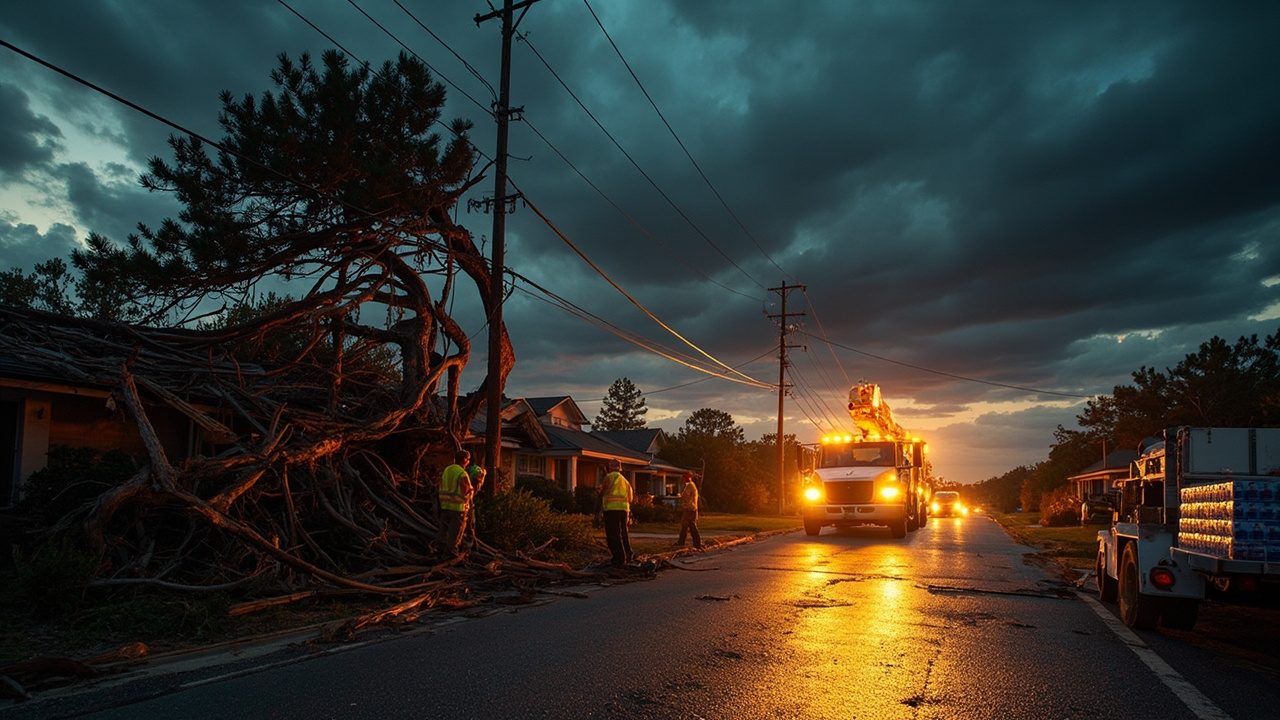
TL;DR: Post-Tropical Cyclone Isaias left more than 415,000 customers without power across Florida, Alabama, Georgia and the Carolinas while its remnants carried soaking rain and flash-flood risk into the Mid-Atlantic and Northeast.
Landfall Near Destin as a Category 2 Hurricane
Isaias came ashore Friday night near Destin, Florida, as a Category 2 hurricane with 105 mph winds, according to NPR.
The National Hurricane Center placed landfall around 8:30 p.m. local time, roughly two hours before high tide in Destin, NPR reported.
The storm brought a storm surge of about 5 feet, below the 6 to 9 feet forecasters said was possible if arrival coincided with peak high tide, according to NPR.
NPR described Isaias as the first hurricane of the Atlantic season and the first hurricane to strike the United States since 2024.
A hurricane warning had extended along the Gulf Coast from Ocean Springs, Mississippi, eastward to the area around Mexico Beach in Florida, according to NPR.
Florida Gov. Ron DeSantis warned residents to prepare for heavy rain and potential tornadoes and said to assume loss of power, NPR reported.
Florida Division of Emergency Management Executive Director Jared Perdue said the Panhandle was already saturated and that flash flooding and localized flooding would occur, according to NPR.
How the Outage Total Reached 415,000
As the remnants of what was Hurricane Isaias moved north, more than 415,000 customers were still without power across Florida, Alabama, Georgia and the Carolinas, according to the American Red Cross.
The monitoring site PowerOutage.us counted nearly 900,000 power customers without power in Florida, Alabama and Georgia on Saturday after landfall Friday night, according to NPR.
By Sunday morning, more than 390,000 people across Florida and Alabama were without power, NPR reported.
In Florida, the worst outages were in Santa Rosa, Holmes, Washington and Walton counties, where more than 80 percent of residents lacked power, according to NPR, citing a morning briefing by Gov. DeSantis.
Alabama Power said at least 95 percent of outages across that state were expected to be restored by midnight Sunday, according to NPR.
Florida Power & Light Company said it hoped to restore power to 95 percent of those affected by Isaias by end of day Monday, according to NPR.
Four Deaths Linked to Wind, Trees and a Generator
At least four deaths were linked to Isaias, including two people killed when trees fell onto homes in Florida and Alabama, according to The Associated Press.
In Escambia County in the far western Florida Panhandle, a rescue team found a person pinned under a large tree shortly before 9 p.m. local time Friday, NPR reported.
Escambia County Sheriff Chip W. Simmons reported a death from carbon monoxide poisoning after a generator was operated in an enclosed room, according to NPR.
Four other people in the same generator incident, ranging in age from 4 to 72, were hospitalized, according to The Associated Press account carried by NBC News.
Escambia County Sheriff Chip Simmons also said a woman was killed when a tree fell on her home and a man died of carbon monoxide fumes from a generator in his garage, according to The Associated Press.
In Jefferson County, Alabama, which includes Birmingham, emergency officials reported a storm-related fatality after a tree fell on a single-family residence, according to NPR.
A fourth death was confirmed in Barbour County southeast of Montgomery, with Alabama Gov. Kay Ivey's office confirming the fatality without providing circumstances in one account, while state emergency management linked a second Alabama death to a vehicle crash involving a downed tree, according to NPR and The Associated Press.
Inland Flooding, Landslides and Rescues in the Carolinas
Steady, soaking rain from Post-Tropical Cyclone Isaias was expected to affect the Mid-Atlantic and Northeast, with flash flooding possible as far north as Connecticut, according to the American Red Cross.
In western North Carolina, rivers overflowed as heavy rainfall raised the risk of flash and urban flooding, according to the National Weather Service as reported by The Associated Press.
Parts of North Carolina saw more than five inches of rain, causing flash flooding and landslides, according to the American Red Cross.
In Burke County, North Carolina, officials reported at least two water rescues, according to The Associated Press.
An unhoused man and woman camping near the Catawba River were caught by floodwaters and rescued with their dog, while a woman trapped in a car in floodwaters outside Morganton was freed, according to The Associated Press.
In McDowell County just west of Burke County, first responders dealt with five landslides and voluntary evacuations overnight Saturday into Sunday while responding to flooded roads and streams overflowing banks, according to The Associated Press.
Nearly a dozen weather stations in that county reported 24-hour rainfall totals from about 5 inches to 9.57 inches at the fire-rescue station in Enola as of 9 a.m. Sunday, according to The Associated Press.
Tornadoes were possible in parts of Virginia and North Carolina, and life-threatening surf and rip current conditions were expected along the Gulf and southeastern Atlantic coasts, according to The Associated Press.
Red Cross Shelters, Meals and Emergency Vehicles
At the height of the storm, the Red Cross opened or supported 21 evacuation centers in Florida, Mississippi and Alabama, according to the American Red Cross.
The focus shifted to damage assessment and distribution of meals and relief supplies where it was safe to do so, according to the American Red Cross.
More than 460 disaster responders were helping as local volunteers and disaster teams from across the country worked together, according to the American Red Cross.
Red Cross disaster volunteers brought Emergency Response Vehicles from across the country to deliver meals, water and essential supplies to affected neighborhoods, according to the American Red Cross.
In Florida, the Red Cross worked with emergency management officials and community partners to distribute food, water and essential supplies and planned feeding sites for hot meals, according to the American Red Cross.
The Red Cross also supported damage assessment and planned to participate in Multi-Agency Resource Centers where people could access help from different sources in one location, according to the American Red Cross update dated October 12, 2026.
In Alabama, Red Cross workers coordinated with emergency officials to assess community needs and provide meals and other support, according to the American Red Cross.
The Red Cross prepositioned shelter supplies and shelf-stable meals in Union City, Georgia, and staged trailers to move relief supplies into affected areas, according to photo captions published by the American Red Cross.
What to Do Without Power
Protect appliances and avoid fire
Unplug appliances and electronics to avoid damage from power surges and leave one light on so restoration is apparent, according to the American Red Cross.
Use flashlights or battery-operated lanterns rather than candles to help avoid fires, according to the American Red Cross.
Do not drive unless necessary because traffic lights will be out and roads could be congested, according to the American Red Cross.
Decide whether to leave if a home is too hot or cold or if medical devices need power, and check with loved ones and neighbors, according to the American Red Cross.
Keep food safe
To prevent illness, keep food cold and when in doubt throw it out, according to the American Red Cross.
Eat fresh, perishable foods first and keep refrigerator and freezer doors closed as much as possible, using coolers with ice if necessary, according to the American Red Cross.
Measure refrigerator and freezer temperature with a thermometer and throw out perishable food that has been warmer than 40 degrees Fahrenheit, according to the American Red Cross.
Use generators outside only
Carbon monoxide can kill, and anyone who feels sick, dizzy or weak should get to fresh air right away, according to the American Red Cross.
Never use a generator, grill, camp stove or other gasoline, propane, natural gas or charcoal burning device inside a home, garage, basement or other partially enclosed area, according to the American Red Cross.
Keep that equipment outside and away from doors, windows and vents, plug appliances directly into the generator, and never plug a generator into a wall outlet, according to the American Red Cross.
Operate the generator on a dry surface, keep it dry, avoid use in wet conditions and do not touch it with wet hands, according to the American Red Cross.
State Crews, Utility Workers and Evacuations
Some 16,000 utility workers were standing by or busy restoring electricity, and crews began work as early as 3 a.m. after landfall night, according to NPR.
The Florida National Guard readied approximately 5,000 personnel to help recovery, according to NPR.
Teams worked to remove trees blocking main roads, and both Interstate 10 and Route 98 were open as of Saturday morning along with all state bridges, according to NPR, citing Gov. DeSantis.
In the Florida Panhandle, many schools and commercial airports shut down, and mandatory or voluntary evacuation orders were in effect for parts of seven counties as of Friday morning, according to NPR.
In Alabama, Gov. Kay Ivey declared a state of emergency for 40 counties, while Gov. DeSantis did the same for 25 counties, according to NPR.
In western North Carolina, the McDowell County emergency management agency posted online that despite a challenging night there were no known injuries or loss of life, according to The Associated Press.
Sources referenced
- Hurricane Isaias: 415,000+ Without Power as Storm Moves North - American Red Cross (https://www.redcross.org/about-us/news-and-events/news/2026/isaias-heads-to-gulf-coast-.html)
- At least 4 deaths attributed to Isaias after hurricane bashes Florida and Alabama : NPR (https://www.npr.org/2026/10/10/g-s1-147632/at-least-2-deaths-attributed-to-isaias-after-hurricane-bashes-florida-and-alabama)