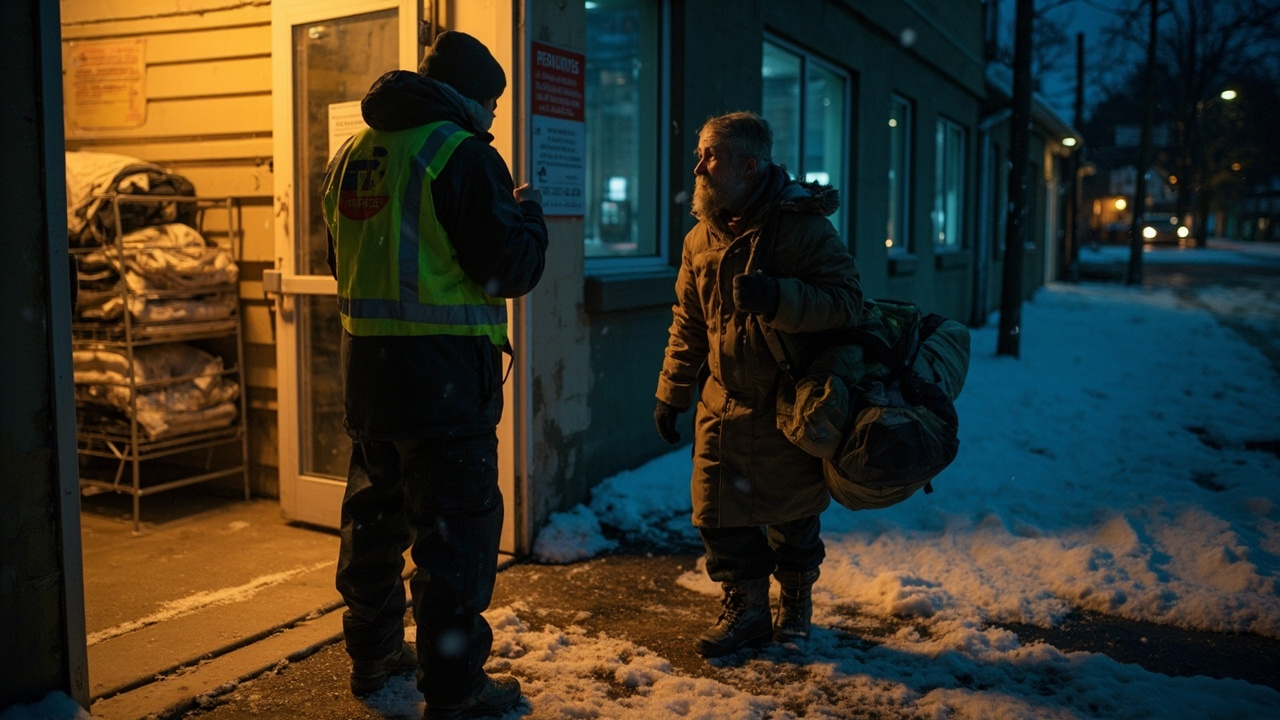
TL;DR: The Asheville-Buncombe Continuum of Care opened its 2026-27 Code Purple emergency shelter season on Nov. 12, 2026, as an unusually cold air mass headed for western North Carolina with wind chills forecast in the 10s and 20s.
The Asheville-Buncombe Continuum of Care has initiated its 2026-27 Code Purple emergency shelter season, according to the city of Asheville, WLOS reported on Nov. 12, 2026. Forecasters expected an unusually cold air mass to reach the mountains on Friday and Saturday, with cold air and gusty winds making it feel like the 10s and 20s, and accumulating snow possible in the western mountains and at higher elevations.
Code Purple is a locally organized program that gives people experiencing homelessness a place to stay when cold or wintry weather hits the region. Two clocks govern it: the season window, and each separate activation.
The season is open; each night is a separate call
Buncombe County's season runs from Nov. 1 through April 30, according to 828newsNOW. Activations follow the forecast: temperatures or wind chills of 32 degrees or below, or temperatures between 33 and 40 degrees paired with precipitation.
An open season therefore does not mean beds are available every night, and a cold night inside an otherwise mild stretch can still trigger shelter.
Where people can go in Buncombe County
The city named two primary sites for this season, per WLOS:
- ABCCM's Transformation Village, for women and women with children.
- Homeward Bound at the Salvation Army's Center of Hope, for men, couples and people with pets.
- Haywood Street Respite, which takes referrals from the primary sites for people with complex needs.
- Safe Shelter, which activates overflow sites when the primary locations fill.
Homeward Bound of Western North Carolina said it is expanding its Code Purple capacity from 20 beds last season to 90 this winter and will operate from the Salvation Army building rather than the AHOPE Day Center, per its Oct. 28, 2026 announcement. The nonprofit expects roughly 7,200 bed stays and more than 150 unique individuals served between November and April.
Homeward Bound Grant Director Sarah Newberry credited the facility arrangement to a partnership worked out with the Salvation Army, saying in the announcement: "We are grateful to Homeless Services Director, Alanna Kinsella, who worked closely with the Salvation Army to solidify a facility partnership for Code Purple this fall."
The money and bed math behind the season
County officials weighed a Code Purple budget of $376,353 for 2026-27, up from $303,000 the year before, and a reimbursement rate of $75 per person per night instead of $39.15, 828newsNOW reported on Oct. 25, 2026. At the higher rate the budget would cover 5,018 bed nights — one person, one night — compared with 7,579 budgeted last season. Shelters recorded 4,426 bed nights of actual use last winter, so the proposal still ran 592 bed nights above real demand.
Capacity is shrinking elsewhere. WLOS reported on Oct. 20, 2026 that officials counted a 105-bed drop in regular and winter shelter capacity alongside an anticipated 44 added Code Purple beds. The Salvation Army planned to pause its 65-bed residential program at the Center of Hope starting Nov. 1, with other services there expected to continue, according to 828newsNOW.
The city and county each budgeted $100,000 for the season, and City Council authorized the city manager to accept and administer the county's share, Asheville.com reported on Nov. 5, 2026. WLOS reported that funding also came from HCA Healthcare/Mission Health and Dogwood Health Trust, with community donations routed through the CoC's fiscal agent, Goodwill of NWNC.
Baltimore uses the same label with a different trigger
Baltimore's 2026-2027 Code Blue Extreme Cold and Winter Shelter Code Purple seasons are scheduled to begin Sunday, Nov. 15, 2026 and continue through March 15, 2027, Mayor Brandon M. Scott's office announced on Nov. 9, 2026.
The city splits its alerts by temperature. The director of the Mayor's Office of Homeless Services declares a Code Purple activation when the forecast, counting wind chill, reaches 32°F or below. The health commissioner declares a Code Blue Extreme Cold Alert at 13°F or below — a figure the city says can be reached when the air is 20°F with 5 mph sustained winds, or 25°F with 15 mph sustained winds — or when other conditions threaten life or health. The two can be declared at the same time.
Overnight shelter runs from 4 p.m. to 9 a.m., and residents reach it through the Baltimore City Shelter Hotline at 443-984-9540. The city's winter shelter page listed the program as inactive in its Nov. 6, 2026 update, ahead of the Nov. 15 start.
Snow response is part of the same push: the city said its Snow Team stands ready with about 294 pieces of City equipment, 300 contractor pieces, more than 15,000 tons of salt and 36,000 gallons of salt brine capacity.
Readiness steps that apply before the first hard freeze
Neither jurisdiction expects residents to watch the thermometer alone. The Continuum of Care offers an email sign-up for notifications when Code Purple is called, and Mayor Scott urged residents to enroll in BMORE Alert, build a severe-weather plan and check on neighbors.
The mayor's office also set out the medical stakes: frostbite, hypothermia and, in severe cases, death can follow long exposure to freezing temperatures and wind. Residents were asked to stay indoors when possible and to look in on people who may need help.
"Cold-related deaths are preventable, and preventing them takes all of us," Health Commissioner Dr. Michelle Taylor said in the Nov. 9 announcement.
What to watch
The CoC Board was scheduled to meet virtually on Nov. 12, 2026, to update commissioners on shelter counts and how preparations went, WLOS reported on Oct. 20, 2026. That report also noted the final Code Purple plan had not yet been approved at the time.
For readers tracking shelter openings elsewhere, our coverage of San Diego's storm shelters shows how quickly activation windows can shift.