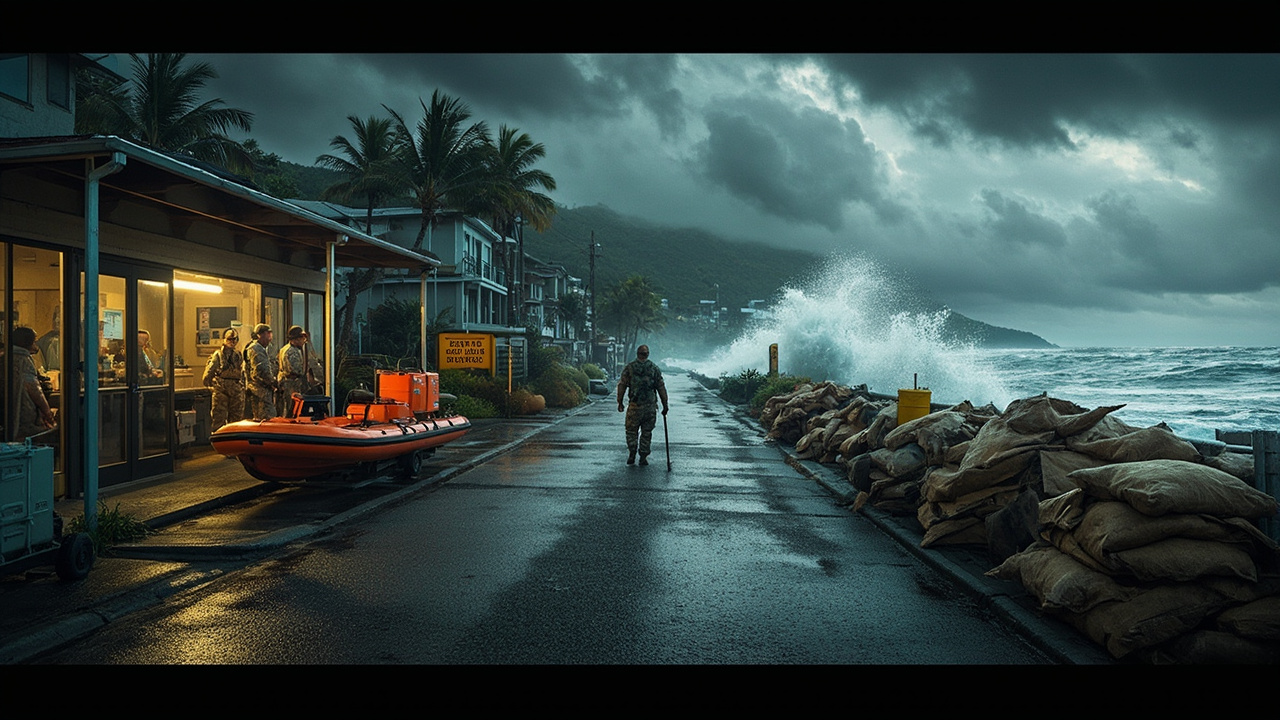
TL;DR: Hawaii secured federal help before Hurricane Nolo's closest approach.
Hawaii received approval of a pre-landfall Presidential Emergency Declaration on September 25, 2026, for Hurricane Nolo, identified in the request as 2026-43 Tropical Cyclone 15E, according to the Office of the Governor – News Release – Gov. Green Announces Approval of Pre-Landfall Presidential Declaration for Hurricane Nolo. Governor Josh Green announced the approval in Honolulu. The action makes federal help available for emergency protective measures before conditions worsen around Hawaii Island on Saturday, September 26.
The declaration covers four jurisdictions: the City and County of Honolulu and the Counties of Hawaii, Maui and Kauai. Support is authorized under Public Assistance Category B, including Direct Federal Assistance, with a 75% federal cost share. The state said coordination will continue with FEMA Region IX, the affected counties, utilities, the U.S. Coast Guard, the U.S. Army Corps of Engineers and other federal and local partners as forecasts and operational needs change.
Who approved what and where it applies
Governor Green said the United States President approved Hawaii's request for the pre-landfall declaration. The governor thanked President Trump, FEMA and federal partners for a quick response, as described in the Governor's announcement.
The same announcement defines the geographic scope. Honolulu, Hawaii, Maui and Kauai counties are included for emergency protective measures. The FEMA alert summary for Hawaii Tropical Storm Nolo, designated EM-3654-HI, likewise lists Hawaii, Honolulu, Kauai and Maui for Public Assistance and states that the incident period began September 23, 2026 and continuing.
The cost arrangement is explicit in the state release. The federal share is 75%. The covered work centers on emergency protective activities rather than longer-term repair programs.
The congressional delegation linked the request to back-to-back storm pressure. U.S. Senators Brian Schatz and Mazie K. Hirono and U.S. Representatives Ed Case and Jill Tokuda said an emergency declaration was critical to ensuring Hawaii had federal resources to prepare for and respond to Nolo while continuing recovery from Hurricanes Lala and Lowell. The delegation urged swift approval of Governor Green's request.
Storm position and intensity on September 25
The Associated Press, reporting carried by PBS News, placed Nolo's center about 185 miles south of South Point, Hawaii and about 380 miles south-southeast of Honolulu on Friday. Maximum sustained winds had increased to 105 mph, making Nolo a Category 2 hurricane. The system was moving north-northeast at about 5 mph.
Forecasters expected Nolo to strengthen further on Saturday. The Governor's release, citing National Weather Service forecasters, said Nolo was expected to reach Category 3 strength during its closest approach to Hawaii Island on Saturday, September 26. The AP report similarly said Nolo was expected to strengthen to a major hurricane on Saturday and then turn west Saturday and avoid a direct strike on the islands.
Tropical-storm conditions were expected to reach land Friday evening, with hurricane conditions possible by early Saturday, the National Hurricane Center said, according to the AP account. Wind gusts on land could reach 50 mph.
Watches in effect for Hawaii Island and Maui
A Hurricane Watch was in effect for Hawaii Island. The state release explained the meaning in operational terms: hurricane conditions were possible within 24 to 36 hours.
For Maui, a Tropical Storm Watch was in effect. That meant tropical-storm-force winds were possible within 36 to 48 hours, according to the same state announcement.
The National Weather Service also warned about coastal flooding from rising water. The Governor's release said a combination of dangerous storm surge and tide would likely flood normally dry areas near the coast as water moved inland from the shoreline. The AP account put the possible surge at 1 to 3 feet, with large and dangerous waves and coastal flooding expected.
Rainfall threat and saturated ground
Rainfall was the central life-safety concern. National Weather Service forecasters predicted up to 25 inches of rain could fall on Hawaii Island Friday and Saturday, causing catastrophic, life-threatening flooding, according to the Governor's release. Heavy rain was also predicted for Maui through the weekend, though in lesser amounts.
The AP provided additional detail on distribution and a revised outlook. Forecasters warned eastern and southern areas of the Big Island could receive 10 to 15 inches, with a maximum of 25 inches. That outlook was lower than an earlier forecast of 15 to 30 inches, with a maximum of 35 inches.
Local conditions increased the risk. The AP reported the heaviest rain was likely over the same southeastern region of the Big Island struck in August by Hurricane Lala, where soils remained wet from additional precipitation. Humanitarian workers on the Big Island spent hours Friday building berms to guide water and moving large debris ahead of the worst rain, Erika Kapu, Hawaii program manager for nonprofit CORE, said in the AP account.
CORE and other nonprofit partners spent the week packing and shipping supplies including camp stoves and hygiene products by air cargo from Oahu to the Big Island for a community relief hub active since Lala, according to the AP. Wheelbarrows and tarps were ordered from big-box stores.
What federal support can fund before landfall
The Governor's release listed seven groups of emergency protective activities supported by the declaration. They focus on staffing, rescue, power, access and logistics.
First, incident-management assistance includes deployment of federal incident-management personnel to support the State Emergency Operations Center and the County of Hawaii Emergency Operations Center in Hilo.
Second, federal search-and-rescue capabilities include swiftwater and flood-rescue teams, equipment, transportation and communications support.
Third, power support includes large-capacity generators, fuel, installation and sustainment for hospitals, water systems, communications facilities and other critical services. A fourth element is technical and logistical assistance for emergency restoration of the electrical grid.
Fifth, emergency debris clearance and removal includes temporary emergency-access measures along Highway 11 through Ka'u and other locations where conditions threaten life, public safety, critical facilities or response operations.
Sixth, disaster mortuary assistance will support ongoing human-remains recovery operations at Naalehu Cemetery following Tropical Cyclone Lala. Seventh, the declaration covers transportation, communications, fuel, water, meals and other logistical support needed to sustain emergency response missions.
Governor Green said Hawaii was facing the storm while continuing response and recovery operations from several prior disasters. He said the federal declaration would help protect lives, maintain access to essential services, support first responders and preserve state capacity to continue ongoing recovery work.
State activation, Guard mobilization and local warnings
The State Emergency Operations Center remained at Level 1, full activation, with 24-hour staffing. State and county agencies were coordinating public warnings, evacuation messaging, shelter planning, flood-channel clearance, emergency road access, search-and-rescue readiness, healthcare preparedness, backup power, debris clearance and protection of critical facilities, according to the Governor's announcement.
Hawaii officials told residents to assemble emergency kits, and the governor issued an emergency proclamation activating more than 230 Hawaii National Guard members, the AP reported. Schools were closed in some areas. An earlier state closure order had shut state and county offices, public schools and University of Hawaii campuses and facilities on Hawaii Island on Thursday, September 24 and Friday, September 25, with closures expanding to Maui County on Friday, September 25.
Hawaii County officials on the Big Island urged residents in flood-prone areas to consider taking refuge at shelters being set up or other locations. Authorities said sand for sandbags was publicly available at several locations. Mayor Kimo Alameda said residents should finish preparations, stay connected to official alerts and weather updates, and secure safe shelter before flooding arrived.
Hawaiian Electric, the state's primary utility, said crews that had been helping restore power in Kauai after Hurricane Lowell would return to Oahu, Maui and the Big Island in preparation for the coming storm, according to the AP account.
What residents were told to do next
The Governor's release directed residents to monitor official information from the National Weather Service, Hawaii Emergency Management Agency, county emergency management agencies and local officials. Residents in threatened areas were told to review evacuation routes, secure property, prepare emergency supplies and be prepared to act quickly if evacuation or shelter instructions were issued.
National Hurricane Center Director Michael Brennan said people on the Big Island should plan to shelter in place in a safe location by later Friday and into Saturday and avoid travel into flooding and high-wind hazards where trees and power lines could fall, as quoted by the AP.
The state also pointed the public to official state and county websites, ready.hawaii.gov and government agencies' social media channels for updates. The Governor's office said operational requirements would evolve with the forecast and that coordination with FEMA Region IX and local partners would continue.
Sources referenced
- Hurricane Nolo threatening Hawaii with heavy rain as Polo churns near Mexico – PBS News (https://www.pbs.org/newshour/nation/hurricane-nolo-threatening-hawaii-with-heavy-rain-as-polo-churns-near-mexico)