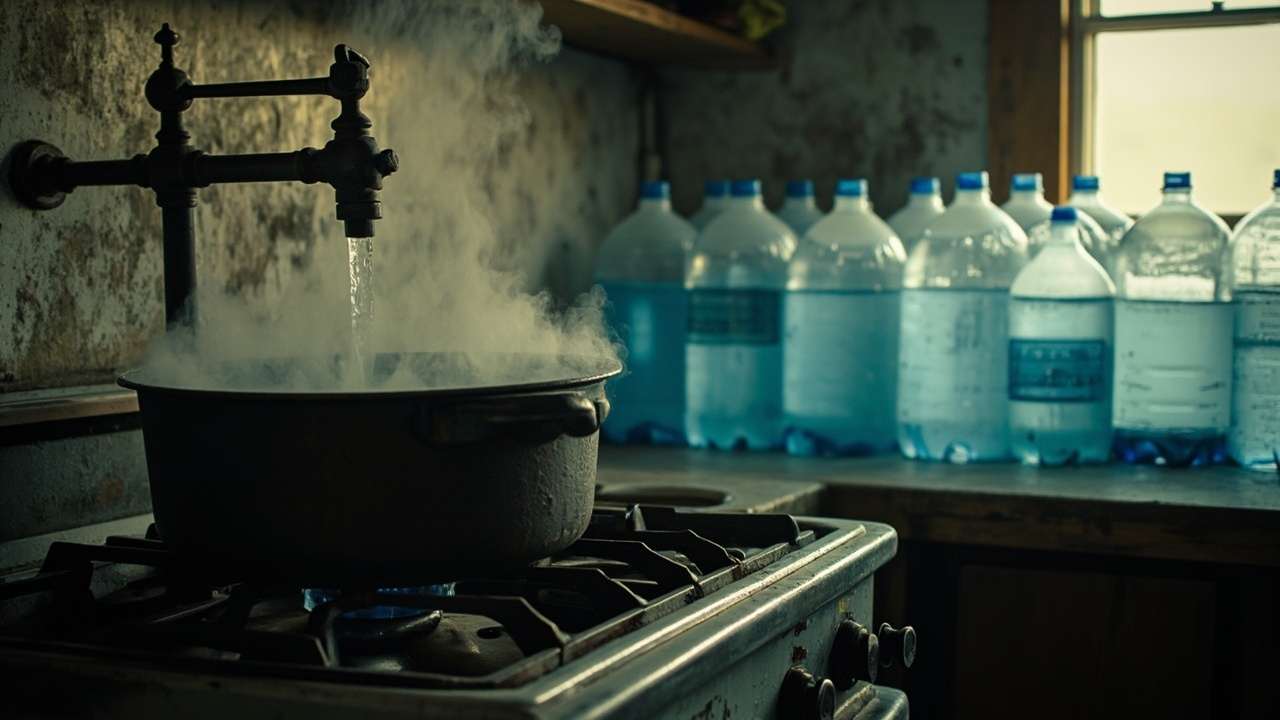
TL;DR: Slick Public Water Supply users in Creek County must use water brought to a full, rolling boil for at least one minute, bottled water, or water from another acceptable source for consumption, food preparation, dishwashing and brushing teeth, after E. coli was found in the drinking water.
Order issued October 3 for Slick Public Water Supply
The Oklahoma Department of Environmental Quality (DEQ) has required Slick Public Water Supply to inform users of its drinking water to take the boil-order precautions described in the agency announcement.
The requirement applies to Slick Public Water Supply, located in Creek County, according to the Oklahoma Department of Environmental Quality news release titled "Boil Order Issued for Slick Public Water Supply."
The release was issued for immediate release on Saturday, October 03, 2026.
The agency contact listed on the announcement is Skylar McElhaney, [email protected].
The order was issued due to E. coli in the drinking water.
Users will be notified when the water is considered safe for human consumption.
Federal law requires that consumers be notified when a public water supply exceeds certain maximum contaminant levels and might be harmful to the health of consumers.
Who must act and what water uses are covered
The DEQ requirement directs users of Slick Public Water Supply drinking water to use the specified alternate water for the listed household uses.
The covered action is to use water that has been brought to a full, rolling boil for at least one minute, bottled water, or water from another acceptable source.
The covered uses are consumption, use in food preparation, dishwashing and brushing teeth.
Consumption is listed first among the uses requiring boiled, bottled or otherwise acceptable water.
Use in food preparation is listed as a separate use requiring boiled, bottled or otherwise acceptable water.
Dishwashing is listed as a separate use requiring boiled, bottled or otherwise acceptable water.
Brushing teeth is listed as a separate use requiring boiled, bottled or otherwise acceptable water.
The instruction to inform users came from the Oklahoma Department of Environmental Quality to Slick Public Water Supply.
Why E. coli triggered a boil order
The stated reason for the order is E. coli in the drinking water.
The announcement does not identify a pipe break, pressure loss, treatment failure or other contributing event as the cause.
The announcement describes the required consumer protection as notification when a public water supply exceeds certain maximum contaminant levels and might be harmful to the health of consumers.
A boil-water advisory generally concerns germs that can be killed by boiling, according to the H2O IQ guide titled "What can I do?"
That distinction matters for planning because different advisories call for different actions, and the H2O IQ guide directs households to follow the issuing authority's instructions rather than assuming boiling solves every problem.
How to boil water for the Slick order
The Slick instruction specifies a full, rolling boil for at least one minute.
Bring clear water to a rolling boil before starting the timing described by the order.
Keep the water at a full, rolling boil for at least one minute to meet the Slick order.
Above 5,000 feet, keep water boiling for 3 minutes, according to the Capable Home guide titled "Emergency water purification | Boiling, bleach, filters & advisories."
Let the boiled water cool before drinking or using it for the listed household purposes.
Boiling is described as the surest way to kill disease-causing viruses, bacteria, and parasites, according to Capable Home.
The extra time described in general boiling guidance gives a wide safety margin, and Capable Home notes that illness-causing organisms die within seconds at boiling temperature while a full minute allows for user differences and adds safety.
Use boiled and cooled water, commercially bottled water, or water from another acceptable source for drinking under the Slick order.
Do not use water or ice from appliances connected to the water line, such as a refrigerator dispenser, during a boil water advisory, according to Capable Home.
Boil tap water before drinking it, cooking with it, brushing teeth or washing dishes, or use commercially bottled water, according to the advisory summary in Capable Home.
Filtered water, cloudy water and ice
During a boil-water advisory, even filtered tap water generally still needs to be boiled unless officials say otherwise, according to H2O IQ.
Boil filtered tap water too during the Slick order unless Slick Public Water Supply or DEQ states otherwise.
Cloudy or colored water makes disinfection work less well because particles can neutralize chemical disinfectants, according to Capable Home.
Clear cloudy water before using any treatment method by filtering it through a clean cloth, paper towel, or coffee filter, according to Capable Home.
Alternatively, let the water settle, then draw off the clear water, according to Capable Home.
Treat the clearer water with one germ-focused method after clearing it.
Clearing water can reduce germs, but it does not make the water safe to drink by itself, according to Capable Home.
Existing ice made while the order is in effect should not be treated as an acceptable source unless it was made with boiled and cooled water, bottled water, or water from another acceptable source.
Safe storage after boiling
After boiling, store drinking water safely in a clean, tightly sealed container to avoid recontamination.
Use clean, sanitized containers with tight covers for cooled boiled water, according to Capable Home.
Let boiled water cool, then place it in clean, sanitized containers with tight covers.
Keep the storage container tightly covered between uses to avoid recontamination.
Boiled water may taste flat, and Capable Home notes that one handling option described by CDC is pouring it between clean containers, then letting it stand for a few hours.
Capable Home also notes another taste option of one pinch of salt per quart or liter.
What boiling does not do
Boiling does not remove chemicals, according to Capable Home.
Disinfection also does not remove heavy metals, salts, or most other chemicals, according to Capable Home.
A do-not-drink advisory may involve chemicals or toxins, and boiling may not make that water safe, according to H2O IQ.
A do-not-use advisory means contact with the water itself may be unsafe, according to H2O IQ.
Do not try to treat water that may contain fuel, toxic chemicals, or radioactive material, according to Capable Home.
Boiling and disinfecting cannot make water with fuel, toxic chemicals or radioactive material safe, according to Capable Home.
Use bottled water or a different source if fuel, toxic chemicals or radioactive material may be present, according to Capable Home.
Contact the health department for advice if fuel, toxic chemicals or radioactive material may be present, according to Capable Home.
For the Slick event, households should follow the issuing authority's instructions rather than relying on a general rule, as emphasized by H2O IQ.
How the all-clear will work
Users will be notified when the water is considered safe for human consumption.
The all-clear notice will identify when Slick Public Water Supply drinking water is considered safe for human consumption.
Until that notice is issued, users should continue using water brought to a full, rolling boil for at least one minute, bottled water, or water from another acceptable source for the four listed uses.
The federal notification principle stated in the DEQ release is that consumers must be notified when a public water supply exceeds certain maximum contaminant levels and might be harmful to the health of consumers.
Contacts, hours and household readiness steps
For questions about the Slick order, the listed agency contact is Skylar McElhaney at [email protected].
The Department of Environmental Quality is located at 707 N Robinson, Oklahoma City, OK, 73102.
The mailing address is Department of Environmental Quality, P.O. Box 1677, Oklahoma City, OK, 73101-1677.
The main DEQ phone number is 405-702-0100.
The main DEQ fax number is 405-702-7102.
Business hours are Monday-Friday 8:00 a.m. to 4:30 p.m., except State holidays.
Households supplied by Slick Public Water Supply should keep enough bottled water or another acceptable source available for consumption, food preparation, dishwashing and brushing teeth until the safe-water notice is issued.
Households should keep clean cloths, paper towels or coffee filters available for clearing cloudy water before boiling, consistent with the cloudy-water steps described by Capable Home.
Households should keep clean, sanitized containers with tight covers available for storing cooled boiled water, consistent with the storage steps described by Capable Home.
Households should keep refrigerator dispensers and connected ice makers out of use for drinking or cooking water until the safe-water notice is issued, consistent with the appliance guidance described by Capable Home.
Households should watch for the utility notice stating that the water is considered safe for human consumption before resuming normal use.
Sources referenced
- What can I do? — H2O IQ (https://www.h2oiq.org/what-can-i-do/)